
However, using Google Trends for SEO is a must if you are to plug into the topics that matter to your target customer.
In this blog post, we’ll cover seven game-changing ways to amplify your search marketing strategy by using Google Trends.
What is Google Trends?
As Google puts it, the trends feature allows you to “explore how the world is searching”.
Regularly misunderstood as just another way to discover search volumes for specific search terms, the helpful tool actually collects data on how often a search term is entered into Google’s search engine relative to a website’s entire search volume over a selected period of time. Not only does Google Trends provide the search volume index of keyword data, alongside its geographical location, it aggregates the data to inform how data trends develop over time.
How does Google Trends Work?
Google Trends taps into real life searches made in the engine to build a sample of data. The data is aggregated, normalised and then categorised. It is the categorisation process that determines the topics that a user can search by. Each topic can also be drilled down by geographical location from any country in the world, right down to your local city.
Each data point is divided by the total number of searches of each location and the time period that is represented so the relative popularity can be compared. This is to prevent the cities and countries with bigger search volumes to automatically be ranked highest. This process therefore provides a more holistic view of the data.
It’s important to remember that a geographical location may show the same level of interest for a specific data trend but that doesn’t mean each of those locations have exactly the same search volumes.
How to Use Google Trends
Despite a complex data collect and normalisation process, using Google Trends couldn’t be simpler! It’s also free which means you can have access to really valuable search trends without spending a penny.
All you have to do is search Google Trends, click through to their Google Trends data dashboard and enter a search term or topic to get started. Make sure you set the desired location from the dropdown in the top right corner and either start with an example from Google or jump right in to find trending data around the topics that matter to you.
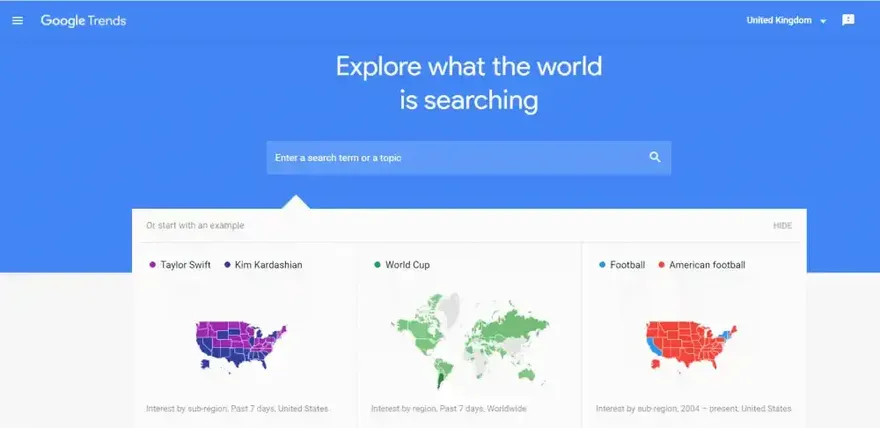
All of the Google Trends data that is shared with us can be utilised in so many different ways. For search marketers, it’s a goldmine that can really underpin how we tailor our search strategy for clients.
So, with that being said, here are seven ways to use Google Trends for SEO and supercharge your search strategy:
1. Find related search terms and topics
When you search for your chosen keyword or topic, the Google Trends data is presented alongside a list of additional terms and topics that Google considers as closely related to your initial search.
Although Google keyword planner also brings up related terms when you have entered in a search, there is crucial difference. Google keyword planner data is based on absolute historical search volume data, whereas this Google Trends feature offers up keywords that are growing in relative popularity right now. This small but significantly different approach to the data will help you build an SEO strategy that caters to the searches people are looking for today, tomorrow and beyond.
A Google Trends analysis comes into play here as Google provides you with a list sorted by popularity, with a percentage alongside each query to quantify the rising search volume. On occasion, the percentage is replaced with the word “breakout” which means that the rising search volume has grown by over 5000%.
The ‘breakout’ queries are the terms to take seriously and analyse whether they will work for your client. That’s because if they are identified early enough and used correctly as part of your SEO strategy, they will not be competitive yet. This gives you the perfect opportunity to capture the number 1 ranking position on Google’s SERP before everyone else jumps on the bandwagon.
The one thing to remember here is that (as many trends fall victim to), they can fade out as quickly as they rose to fame. This is something search marketers must monitor closely to make sure they are not building evergreen content on reactive search queries that realistically are just a ‘fad’.
2. Gain a competitive advantage
You can also use Google Trends to keep an eye on the competition and conduct a like-for-like comparison of data.
There are two ways to do this, firstly you can type in your brand and discover the Google Trends data attached to your brand only. You can then take a look at related queries underneath and see if people who are searching for your brand are also searching for your competition.
As a business, you will have a good idea of who your competitors are. However, this helpful feature confirms who is your direct competition according to people that matter the most – your target audience.
This type of audience could be defined as users who are still considering their options before committing to a purchase. You can therefore gain a competitive advantage here by creating content that educates and informs the reader how you compare with (and supersede) the competition.
Secondly, you can compare your brand with your competition by simply clicking ‘compare’ once you have searched for your brand term.
For example, let’s look at Hello Fresh. Their brand visibility has grown exponentially as a result of their brand building activity combined with the environmental factors surrounding the multiple lockdowns we’ve faced over the last year: