United Kingdom
What Are AI Overviews and When Are They Generated?
AI overviews are a fairly new addition to the search engine results page (SERP), but what exactly are they, when do they appear, and how can they affect your search engine optimisation (SEO) strategy?
What Are AI Overviews?
AI Overviews are an organic Google Search feature that uses generative AI to summarise relevant content and provide quick answers to user queries. By synthesising data and condensing information into a single package, they provide automated insights and save users from sifting through multiple websites to find what they need.
They typically appear at the top of the SERP, in position zero, with links to content sources. Through clear headings, bullet points and short paragraphs, AI Overviews present information logically for easy user consumption. While Google uses Gemini to generate AI Overviews, Microsoft Bing has incorporated AI summaries via Copilot.
They typically appear at the top of the SERP, in position zero, with links to content sources. Through clear headings, bullet points and short paragraphs, AI Overviews present information logically for easy user consumption. While Google uses Gemini to generate AI Overviews, Microsoft Bing has incorporated AI summaries via Copilot.
How Do AI Overviews Work?
AI Overviews appear when the search engine determines that a generative AI response could provide users with helpful information. Google aims to display AI Overviews for complex queries that would traditionally require multiple searches. Likewise, AI Overviews do not tend to appear when they are not deemed to add value to search results, or for:
- Sensitive ‘Your Money or Your Life’ topics which could impact your health or finances
- Very specific or factual search intent
- Incognito mode
- Certain browsers
- Browsers with ad-blockers enabled
Gemini, Google’s own large language model (LLM), generates the content in these summaries. These advanced generative AI models scan the search engine’s index for relevant and reliable sources, identify key points and synthesise data into a concise summary.
Relevance in sources amounts to how well the page ‘answers’ the query, relative to keyword usage and search intent. Quality and authority also come into play, which content can achieve by demonstrating expertise, experience, authoritiativeness and trustworthiness (EEAT) and earning votes of confidence in the form of reputable backlinks.
Differences to featured snippets and AI mode
Alongside Overviews, Google SERPs use featured snippets and AI mode. While your content could appear in any of these SERP features, their primary functions and information sources differ in fundamental ways.
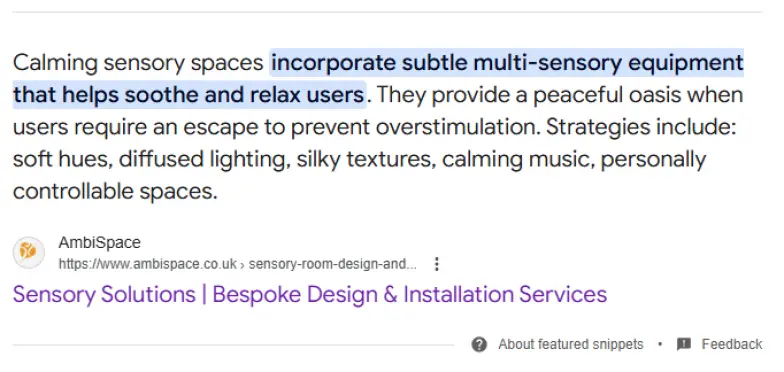
Unlike AI Overviews, which aggregate information from multiple sources and present a synthesised summary, the featured snippet quotes an answer to a specific question, such as a definition, taken verbatim from a single website.
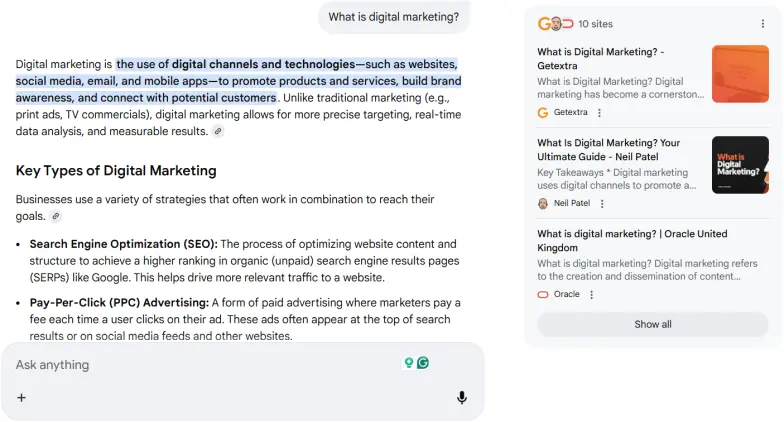
AI mode is different again, providing an end-to-end conversational experience through real-time data processing and advanced reasoning. Google uses Gemini to create a fully interactive interface which allows for follow-up questions and iterations on the original query.
Expansion of ads in AI Overviews
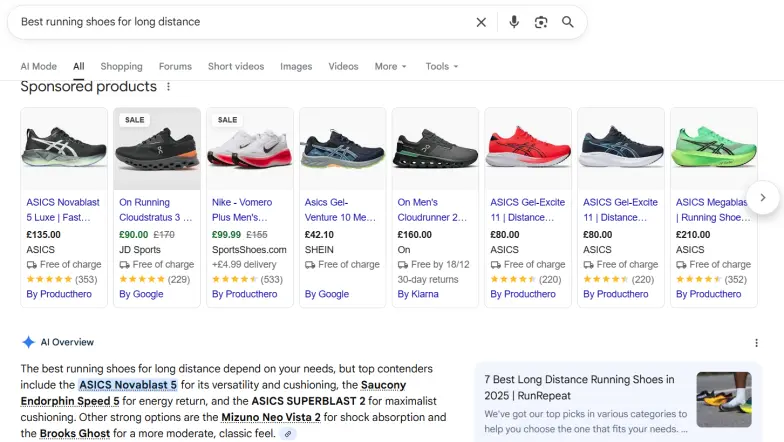
Google has gone beyond sponsored search results and begun integrating paid advertising into AI Overviews to open prominent placements and maintain its core revenue stream. Ads, often product carousels with images and prices, can be inserted in and around the Google AI Overview when the algorithm detects a strong commercial intent (e.g. ‘best running shoes’).
So, paid ads are affected similarly to ranked search results and must now jostle for position in and around the AI Overview. This is something else digital marketers must consider when weighing up efforts to drive organic traffic and PPC.
Why Are AI Overviews Important?
It is a fact that AI has transformed the world of SEO. There is already evidence that AI summaries are driving an increase in zero-click searches, reducing organic traffic for websites appearing below the summary. This is because, having received answers up front, many users no longer feel the need to explore their topic further.
The use of AI in content marketing is more prevalent than ever, helping to personalise content and automate processes so digital marketers can reach larger audiences and secure more conversions. But, like generative AI and LLMs, AI Overviews present both benefits and challenges.
Benefits:
- The quality of organic traffic is improving. Users who still click through to your site after reading an AI Overview are interested in obtaining a deeper understanding.
- In turn, this could mean better engagement, higher conversion rates and reduced bounce rates with visitors who are more likely to become customers.
- Of course, if your website appears in an AI Overview, this massively enhances your brand visibility by putting your content directly in front of users.
Challenges:
- When users find what they need without visiting any websites, this reduces organic traffic and revenue for businesses, who may have to rely on paid methods instead.
- Given that AI Overviews extract content from authoritative sources, it is harder for newer or smaller websites to gain visibility and establish a reputation online.
- As Google AI Overviews evolve and become more complex, they are increasingly prioritising visual content over text answers.
How to Optimise for AI Overviews
SEO is becoming more sophisticated, and digital marketers can now optimise content specifically for AI Overviews. For instance, recent Semrush updates allow users to view how their website is performing against certain keywords in SERP features, and therefore optimise specific URLs for AI visibility.
However, following content optimisation best practices gives you the best chance of featuring in AI Overviews:
Content strategy and quality
- Target long-tail keywords - focusing on specific, question-based search phrases aligns your content with the informational queries that often trigger AI Overviews.
- Answer questions concisely - provide a direct answer to your main question early in your content before expanding on the topic.
- Keep content fresh - regularly review and update your content to signal to the AI that your information is current and reliable.
Formatting and structure
- Use hierarchy-driven headings - structure your content logically using clear H1, H2 and H3 tags to help the AI quickly identify and extract key information.
- Break up information - present information in easily digestible chunks using bulleted lists, numbered steps and short paragraphs.
- Optimise for existing SERP features - content that already ranks for featured snippets and ‘People Also Ask’ questions is often structured well.
Technical SEO
- Ensure webpages are crawlable and indexable - create a solid technical SEO foundation by enabling search engines to efficiently access and read your content.
- Build backlinks - high-quality backlinks from reputable sources signal to search engines and AI that your content is credible and authoritative.
- Ensure webpages are fast, secure and responsive - like search engines and AI, you should prioritise the user experience on your website.
- Implement schema markup - enable structured data on your pages, which describes your content and helps AI understand and cite it.
How to Track AI Overview Click Data
You can see whether your website is appearing in AI Overviews using various SEO tools.
Google Search Console: Your AI Overview click data is combined with overall traffic in your performance report. To estimate your AI Overview performance, look for queries with a very high average position but a lower-than-expected click-through rate. Top-ranking pages with few clicks may indicate that an AI Overview appears for these queries, saving users from needing to visit websites.
Semrush: If your website is appearing in AI Overviews, you can find your statistics in the Semrush SEO under Domain Overview. Here, Semrush breaks the data down into visibility, mentions and cited pages. Further down, under Google SERP Positions Distribution, is the share of your website’s SERP positions across organic results, AI Overviews and other SERP features.
Ahrefs: This SEO tool also shows which pages trigger AI Overviews and how often your domain is linked to. Find this information at the top of your Overview page, along with your backlink profile and overall search performance.
How to Get Out of AI Overviews
That said, there are several reasons you may wish to keep your website out of AI Overviews, including concerns around copyright and accuracy. Given that they pull information from multiple sources, AI Overviews can miss details and misrepresent brand values. Businesses can therefore struggle to control how they are perceived in search results.
There is no way to opt out of Google AI Overviews directly, but you can use traditional SEO methods to reduce the likelihood that your content will appear. Proceed with caution, however, as vanishing from AI Overviews means vanishing from search engine results pages altogether and potentially sacrificing organic traffic.
Use robots.txt: Your robots.txt file can instruct search engines not to crawl certain pages. This may not prevent them from being indexed, but your content is much less likely to appear in AI Overviews.
Use the noindex tag: Add a noindex meta tag to instruct search engines not to index certain pages. This content will appear in neither AI Overviews nor normal search results.
Use the nosnippet tag: The nosnippet meta tag prevents search engines from generating a text snippet for your pages in normal search results and summarising your content in an AI Overview.
While these methods can limit exposure in AI Overviews, there are consequences to rejecting the Google AI search engine tool. If you are unsure which course of action to take, please get in touch for an initial consultation with our technical SEO experts.
How Zelst Can Help You Be Seen and Get Found in AI Overviews
As decision-making tools go, AI Overviews are very accessible and very popular. They have forever changed how people seek information and navigate SERPs, while presenting digital marketers with a fresh array of benefits and challenges.
If you are labouring for conversions online, Zelst can help. We engineer visibility, authority and measurable business objectives so you can stand out in the online crowd. Contact us today for a free site assessment and to unlock high-quality, strategic SEO guidance.