
 United Kingdom
Zero-Click Searches: Why SEO Metrics Need to Change
As AI overviews appear more frequently in search results, our approach to and understanding of search visibility needs to evolve. Optimizing your website for zero-click searches should be a priority, but it is equally important to update your perception of SEO success.
What Is a Zero-Click Search?
Zero-click searches occur when user queries are answered directly on the search engine results page (SERP), eliminating the need to click on a website. These types of searches are facilitated by the SERP features generated by Google and other search engines, which draw information from websites and display it on the results page. These features include:
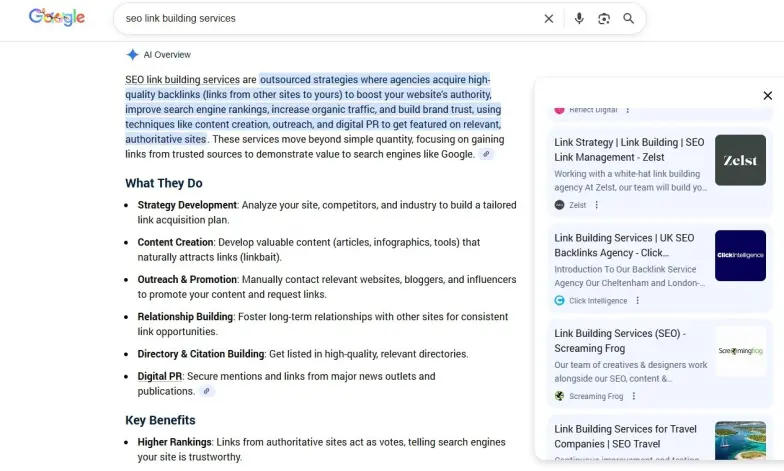
- AI Overviews
Launched on Google in May 2024, AI overviews are summaries of information produced by generative AI that appear at the top of the results page. By analyzing sources of data related to the search query, AI overviews synthesize the retrieved information into text and images that provide an answer to the user’s question.
AI overviews typically feature a single paragraph, followed by bullet-pointed information providing further insight into the query. As of October 2024, sources started appearing alongside AI overviews, allowing users to explore the origins of the summarized information.
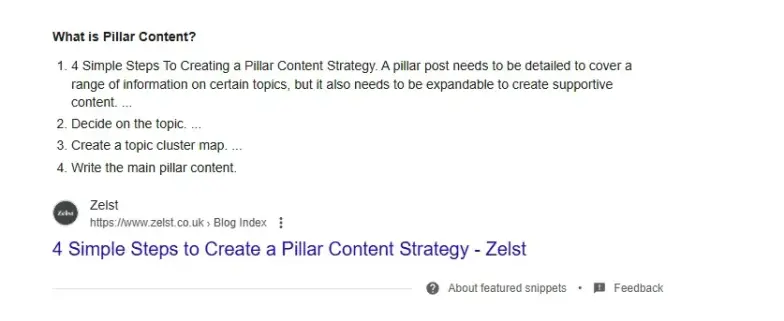
Introduced in January 2014, featured snippets are blocks of text that are taken verbatim from one of the top-ranking websites on the results page. While the link to the source of the featured snippet is clickable below the extracted text, these SERP features are often responsible for zero-click searches as they provide succinct answers to user queries.
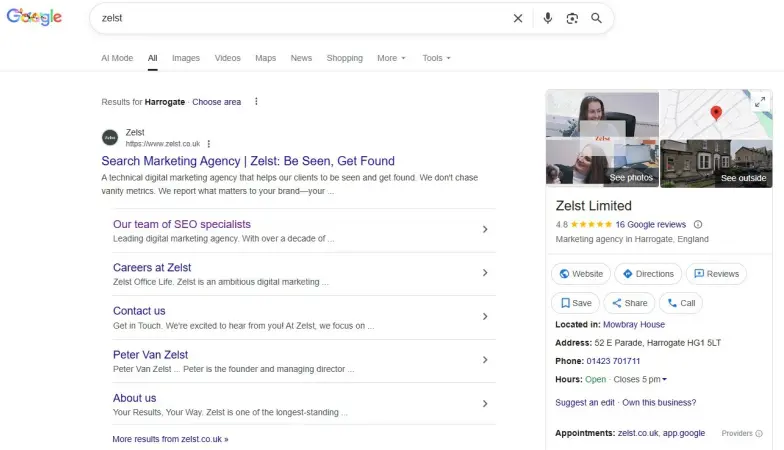
- Knowledge Panels
Unlike the previous SERP features, which appear at the top of the result page, knowledge panels are located to the right of the search results, providing structured information about people, places and brands. This information is typically retrieved from databases, such as Wikipedia, or websites owned by or associated with the person or brand being queried.
While links are provided to the relevant sites, these SERP features can result in zero-click searches when the user is looking for basic information, such as birthdays, contact details or opening hours.
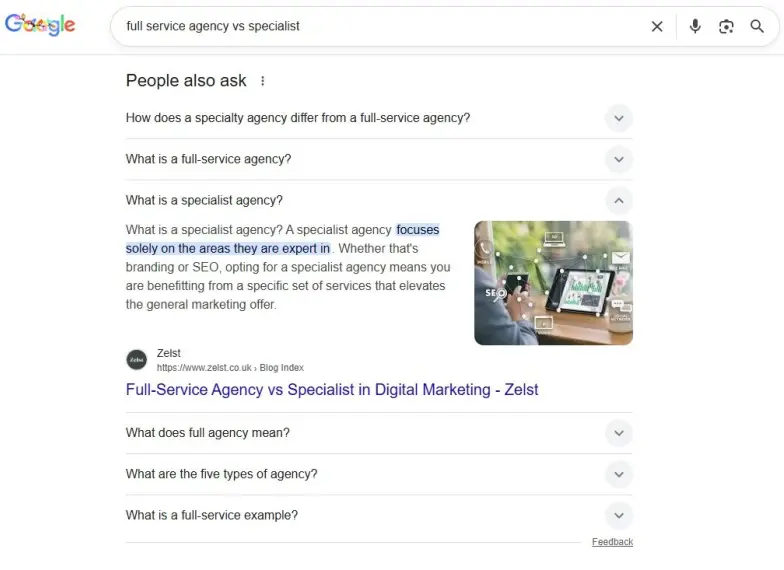
- People Also Ask (PAA)
Rather than provide direct answers to user questions, the People Also Ask (PAA) feature lists questions related to the search query, which can be clicked to reveal summaries or snippets alongside links to related websites. As you click to expand each PAA result, the SERP will generate more related questions with the aim of getting you closer to your desired answer.
- Local Packs
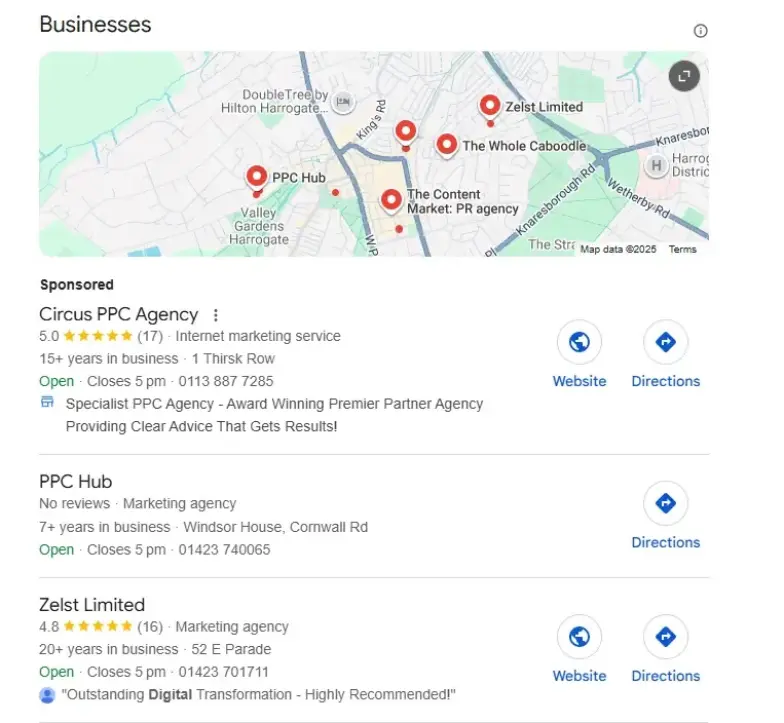
Sometimes called map packs, local packs are large boxes containing an interactive map of your local area as well as three reputable businesses related to your transactional query. In addition to providing geographic information about where these businesses are relative to your current location, this local SEO feature displays the address, contact details and reviews of the highlighted businesses.
Why has there been a Rise in Zero-Click Searches?
From receiving succinct answers to search queries to turning to alternative search engines, the rise of zero-click searches can be attributed to changing attitudes around search as much as algorithmic and technological advancements. The primary reasons for the increase in zero-click searches include:
- Introduction of AI Overviews
The influence that AI overviews have had on the rise of zero-click searches cannot be understated. As of March 2025, Semrush found that 13.14% of search queries prompted the generation of an AI overview, more than double the 6.49% recorded in January 2025. At the end of 2024, audience intelligence platform SparkToro published findings that 58.5% of American queries were answered without a click, while zero-click searches comprised 59.7% of European searches.
- Large Language Models (LLMs)
Despite traditional search engines integrating AI into their platforms, users are increasingly turning to LLMs such as ChatGPT and Perplexity to streamline informational and even transactional searches. In a survey conducted by global consultancy firm Bain & Company, they revealed that 68% of LLM users leveraged the platforms for research and data gathering, 48% for updates on current news and weather reporting, and 42% for recommendations for online shopping.
- Social Media Searches
While some users are satisfied with the results produced by AI overviews or LLMs, others value the authenticity provided by social media influencers on platforms like TikTok, X and Instagram. In the age of parasocial relationships, many younger users feel more inclined to trust recommendations provided by content creators rather than algorithms or AI chatbots, advancing the sales funnel earlier and thereby increasing the number of zero-click searches.
How to Optimise Your Website for Zero-Click Searches
From realigning your keyword targeting to showcasing your specialist expertise and experience in your next content campaign, there are many SEO strategies that your business can employ to optimize your website to appear more frequently in zero-click searches. These include:
- Keyword Targeting
While traditional keyword research prioritizes terms with high search volumes and click-through rates (CTR), to get value from zero-click searches, it is important to consider the search intent. The queries that tend to trigger generative AI responses are overwhelmingly informational in their intent, expressed as questions that start with interrogative phrases such as ‘how', ‘what’, ‘why’, 'when' and ‘where’. By targeting long-tail keywords and phrases while providing direct answers to said questions in your content, you can increase the likelihood of being quoted or cited in zero-click searches, such as AI overviews and featured snippets.
- Content Structure
When improving your visibility in zero-click searches, it is essential to structure your content to make it easier for search engine algorithms to crawl and extract direct answers. The most effective way to achieve this is to answer the question to your long-tail keyword phrase at the start of your content, providing your answer as quickly and concisely as possible. The rest of your content should adopt a journalistic style, presenting the most critical information early before moving on to supporting information and deeper analysis later in the piece.
- Improving E-E-A-T
For your content to be cited in AI overviews or for your brand to be mentioned in certain contexts, you need to ensure that Experience, Expertise, Authoritativeness and Trustworthiness (E-E-A-T) factors are clearly demonstrated through your on-page content and technical SEO strategies. Creating content that highlights your understanding and proficiency in your area of expertise is highly valued by the algorithm, while earning backlinks to your site from other reputable sources is essential to securing your authority on the internet.
- Improving Internal Linking
Internal linking helps both users and AI understand your site. It creates a clear structure, shows how topics relate to each other, and improves crawl efficiency, which is so important if content is to be discovered quickly. It also supports engagement by guiding users to relevant content, and concentrates link value on priority pages.
Improving internal linking makes the site easier to navigate, easier to interpret, and easier to rank, in both traditional search and AI-driven experiences, such as Google’s SGE. As AI agents increasingly explore sites on users’ behalf, strong internal linking becomes a key signal of depth, relevance, and authority.
- Local SEO
Populating your website with accurate addresses and easily crawlable contact information is crucial to your zero-click search optimization strategy, especially if you want to appear in local packs or knowledge panels. Creating individual location pages for each of your outlets, offices or areas of service makes it easier for the algorithm to find and categorize your local operations, while featuring local-specific testimonials and reviews increases your odds of ranking in the top three businesses in the local pack.
- Schema Markup
Implementing relevant schema markup on your pages allows you to add structured data to your website, making it easier for algorithms and LLMs to crawl your content and incorporate it within the synthesis of zero-click search results, such as featured snippets and AI overviews. This technique is most effective when performed on URLs with an optimized structure, such as Frequently Asked Questions (FAQs) pages and step-by-step instructions, which the algorithm can extract and replicate with the utmost ease.
- Monitoring Zero-Click Search Metrics
As traditional metrics such as organic traffic and CTR become less reliable indicators of success, the metrics you track for zero-click searches need to adapt to accurately gauge the impact of your revised strategy.
How Have Zero-Click Searches Impacted SEO?
The immediate impact of zero-click searches on SEO was recognized across the digital marketing landscape, with key thought leaders highlighting the dramatic decline in organic traffic and signaling the shift towards visibility over website traffic. To provide clear guidance and advice to our clients on the ongoing conversation about zero-click searches, we at Zelst conducted our own analysis before assessing how the rise in zero-click searches should be reflected in future marketing strategies.
From an analysis of 54 websites from the UK and USA, of varying sizes (from 1,000 monthly impressions to 100,000 monthly impressions) across over 20 industries, using data from Google Search Console we found that, on average, organic clicks decreased by 8% in the months following the introduction of Google AI overviews (April to June 2024) and by a further 14% in the following year (June 2024 to June 2025). However, our clients’ visibility, based on impressions, increased substantially in the same timeframes, rising 106% between April and June 2024 and then 91% over the next 12 months.
Overall search rankings, according to Google Search Console, were also seemingly affected by zero-click searches, decreasing by 2% between April and June 2024 and by 11% over the next year. Interestingly, the average number of homepage visits driven by a brand search (search using the brand's name) rose by 13% in the first two months and then by 21% between June 2024 and June 2025.
From these trends, we can surmise that by increasing the appearance of a website in search results that don't necessitate a click, a brand's visibility is elevated. The result of this is an increase in people looking for that brand and an increase in status and likely engagement. Our research also found an increase in engagement on the majority of sites, assessed by pages per visit, time on site and on-page, and conversion events. This would substantiate the argument that we should reconsider our approach to monitoring digital marketing metrics.
Which Metrics Should You Track for Zero-Click Searches?
As zero-click searches become progressively prominent and businesses are forced to adapt their approach to visibility, having an awareness of the correct metrics to monitor will be vital to ensure you can gauge the success of your new strategies. Some of the metrics you should be tracking include:
- AI Visibility Score
This relatively new metric quantifies the presence of your brand and its content in SERP features as well as on generative AI tools and LLM platforms. Combining data relating to the number of times your brand has been mentioned, your content cited, and the position of your citation on zero-click search features, a score out of 100 is awarded for your performance relative to your target keywords.
- SERP Feature Share
This metric provides a more straightforward assessment of your visibility in zero-click search features, showing your percentage share of featured snippets, PAA, local packs and knowledge panels. This can provide more insights into how you are performing against particular search intents and offer guidance on how to expand your future marketing efforts.
- Brand Mention Sentiment
Rather than simply monitoring your visibility level, this metric allows you to evaluate the quality of your mentions to assess how your brand is being perceived. By analyzing social media interactions, online reviews and mentions in blogs, forums and news articles, a positive, neutral or negative brand mention sentiment is provided, relative to your targeted keywords.
- Question Coverage Rate
In light of the increased importance of E-E-A-T, this metric can be extremely useful to determine how effectively your content addresses the queries and answers the questions posed by your audience. After identifying the central topic you are targeting with your content, an algorithm will compare your content against all the long-tail keywords being generated by users to determine what percentage of questions you are directly answering. Optimizing content with lower question coverage rates should be a priority of your zero-click search strategy.
- Search Visibility
SEO visibility is a metric which represents where and how frequently a website appears in organic (unsponsored) search engine results for their set of target keywords. It is essential that we monitor this to understand how a brand is seen and gets found.
Optimise Your Website for Zero-Click Searches with Zelst
We hope this article has been an accessible introduction to zero-click searches or has deepened your understanding of this radical shift in digital marketing. Whether your business has been struggling since the advent of AI overviews or your current zero-click search strategy has not yet returned the results you want, our talented team of content marketing, technical SEO and biddable media specialists are eager to lend their expertise.
For more information about Zelst’s SEO services, or to discuss the challenges your business or website faces, please contact us today so that Zelst can support you with your latest strategy.

